

Telethon Trust Research Fellows celebrate milestone anniversary
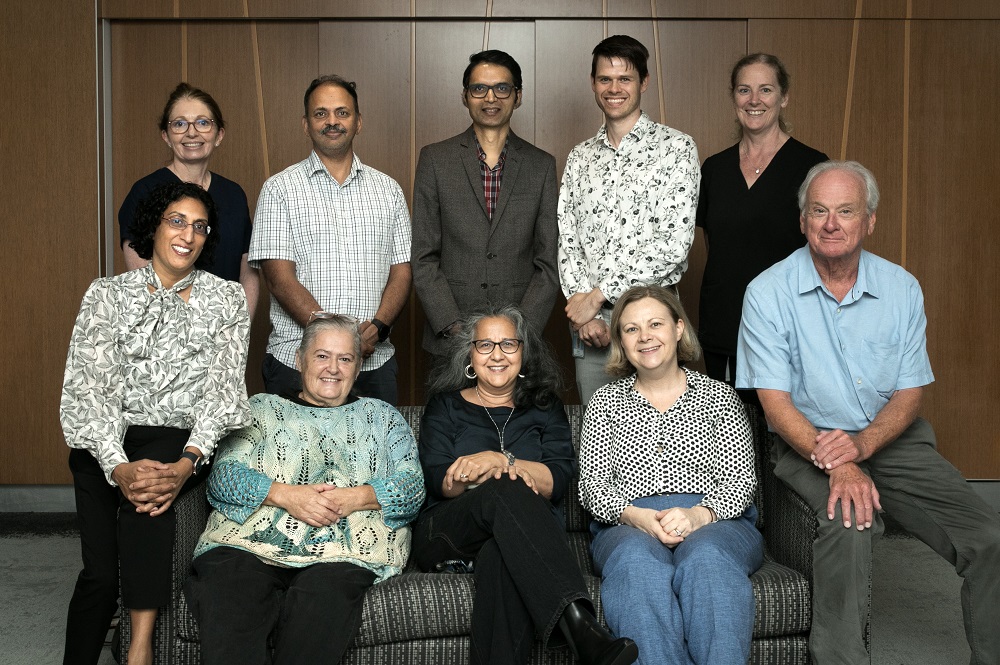 Back row: Stephanie Weston, Srinivas Poreddy, Abhijeet Rakshasbhuvankar, David Cullingford, Rebecca Thomas. Front row: Sarah Cherian, Christine Jeffries-Stokes, Veena Judge, Jacqueline Curran, Tim Jones.
The Channel 7 Telethon Trust marks a major milestone this week, celebrating 40 years of investing in child health research through its Telethon Trust Research Fellowships.
A springboard for paediatric clinicians in the early stages of their research careers, the Fellowships have helped foster a vibrant research culture at Perth Children’s Hospital (PCH) and across WA’s broader Child and Adolescent Health Service (CAHS) that improves care for WA children and increases their access to cutting-edge treatments and therapies.
The fellowships have helped nurture some of WA’s foremost child health investigators, whose contributions to science include insights and breakthroughs that have transformed practice here and around the world.
Among them is original fellow, Professor Tim Jones, AM, who notes that prior to the Telethon Fellowships, there was no support for aspiring young researchers.
‘If you wanted to get into research, your only option was to go interstate or overseas,’ he says.
‘So, the establishment of the fellowships was a real turning point for child health research here.
‘As well as enabling us to play a direct role in improving health outcomes, it enabled us to retain our top clinicians.’
Today Tim is Director of Research at CAHS. He is also an endocrinology and diabetes consultant who is recognised internationally for his investigations into childhood diabetes, particularly hypoglycaemia and diabetes treatment.
Tim’s fellowship project paved the way for the establishment of WA’s child diabetes registry which has enabled he and his fellow researchers ‘to learn so much about diabetes’.
‘Thanks to our improved understanding of the condition and how to treat it, children with diabetes today are leading more normal lives.’
Like many of the Telethon Trust alumni, Tim sees the real value of the fellowships as not just in the improvements that stem from individual projects or the opportunities they open up for recipients, but in their ability to build research capacity.
‘It is the ability of fellows to generate further research funding, to expand on their research, to forge new collaborations and inspire those around them,’ he says.
‘Through sharing their skills and insights, mentoring and passing on their passion for discovery, the fellows create an enduring legacy.’
The impact of Fellows’ legacy can be found across and beyond CAHS, including through the work of:
- Professor Meredith Borland, AM, whose research into intranasal fentanyl helped revolutionise pain management for children in emergency care around the world. Meredith is regarded as a pioneer in emergency medicine, with more than 200 peer-reviewed publications to her name – several of which have influenced clinical practice internationally.
- Professor André Schultz whose fellowship project into the use of spacers for managing asthma changed international asthma guidelines. Today he is a recognised leader in paediatric respiratory medicine who has led many major investigations including one that significantly reduced rates of chronic wet cough in Aboriginal children.
- Dr Christine Jeffries-Stokes, AM, whose groundbreaking Fellowship project highlighted the value of culturally appropriate care. An Aboriginal community-led maternal and infant health service she helped establish in the Eastern Goldfields, transformed that community’s maternal and infant health outcomes from the worst in the nation to the best in the nation within the space of a decade.
- Clinical Associate Professor Sarah Cherian, whose fellowship project on Helicobacter pylori infection in African refugee children, embedding of evidenced-based clinical research into the CAHS’ Refugee Service and use of data to improve health equity, has shaped WA’s reputation as the nation’s leader in paediatric refugee health.
- Professor Gareth Baynam whose fellowship project into genetic influences on children’s responses to vaccines launched a career that has attracted more than $450 million in research funding to WA and international recognition as the world’s number 2 ranked practising rare disease researcher. It has also led to improved care for children with rare and undiagnosed health conditions, through the forging of international collaborations and networks and the establishment of WA’s Undiagnosed Diseases Program and PCH’s Rare Care Centre.
- Dr Wei Hao Lee whose fellowship project – and research stemming from it – has improved the management of children presenting to PCH’s emergency department with suspected appendicitis.
- Dr Rachael Marpole whose fellowship project on reducing respiratory illness in children with cerebral palsy has paved the way for a program that is helping families work with their health professionals to detect and manage early signs of respiratory illness in children with the condition.
- Dr Maina Kava whose fellowship project was the first paediatric study in Australia to look at peripheral neuropathy in children on cancer chemotherapy. Today Maina is a paediatric neurologist and metabolic consultant at PCH. She is also the clinical lead for its neuromuscular and the neurometabolic program and leads pharma-sponsored clinical trials for neuromuscular, metabolic and neurodevelopmental disorders.
These are just some of the approximately 100 clinician researchers who have been awarded Telethon Trust Research Fellowships over the past 40 years. All have made important contributions to science that continue to advance the care and health outcomes of children in Western Australia and beyond.